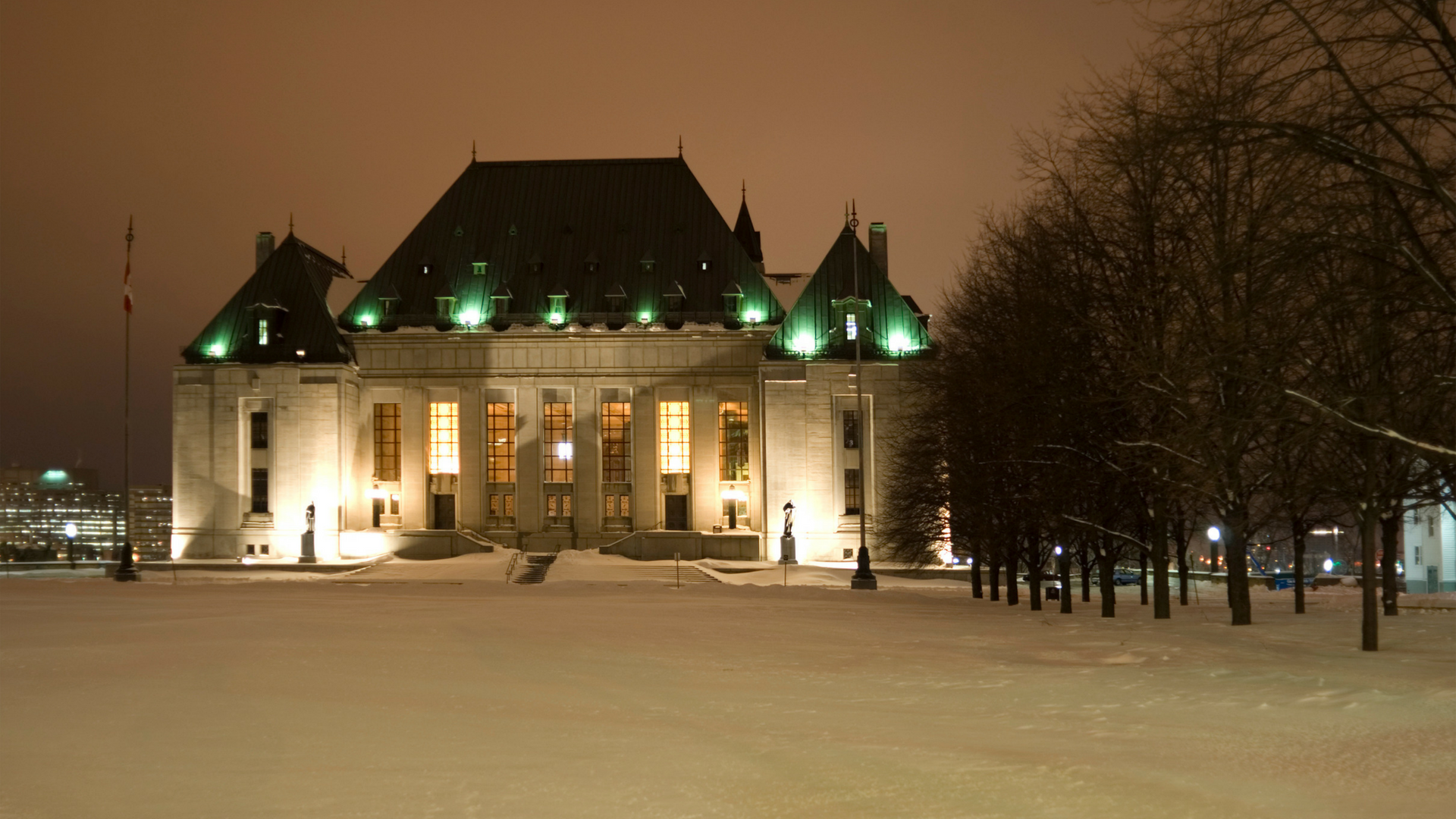
Supreme Court of Canada Appeals & Interventions
Ensuring First Nations’ voices are heard clearly in the highest court in the land.

Supreme Court of Canada Appeals & Interventions Lawyers for First Nations
We act as lead or co-counsel on Supreme Court of Canada (SCC) applications for leave to appeal, motions, interventions and substantive appeals for First Nations. We also provide drafting, review and analysis services to First Nations’ legal counsel preparing SCC arguments and materials where the input of external counsel is desired on such important issues before the highest court in the land. We respect all referrals from lower appellate court counsel.
The low leave to appeal grant rate (only about 10%), number of judges you'll be dealing with on an appeal (between 5 and 9), amount of virtual paper you'll be filing if you or others others are granted intervenor status (potentially a roomful stacked to the ceiling) and ways you need to craft your issues to get the Court's attention means that having the help of counsel experienced with Supreme Court of Canada matters will maximize your prospects of success in seeking or opposing leave, bringing an intervention application, and acting on appeals as appellant, respondent or intervenor.
First Nations peoples are often before the SCC, either intervening in the cases of others to ensure their rights and perspectives are taken into account, or as parties because of the fundamental constitutionally entrenched Aboriginal Rights and Treaty Rights, including Title, that they are repeatedly compelled to defend. While in a truly just world, repeated resort to the SCC wouldn’t be necessary, many of the greatest advances in First Nation rights over the past 50 years have come about as a result of Supreme Court of Canada decisions, making First Nation efforts to get in front of the SCC always a worthwhile effort.
The firm’s Senior Barrister Gordon Scott Campbell has appeared multiple times as counsel at the Supreme Court of Canada for both appellants and respondents, including in what remains the Court’s leading Indigenous and Aboriginal Treaty Rights case of R. v. Marshall, [1999] 3 SCR 465, as well as worked on numerous interventions and applications for leave to appeal.
He has worked in every province and territory of Canada, served with the Department of Justice Canada’s Ontario and Atlantic Regional Offices (including as Constitutional Issues Coordinator), as well as with the Constitutional Law Branch of the Attorney General of Ontario, prior to founding First Nations Advocates. He practices equally in French and English, holding both civil law and common law degrees, enabling him to deal with SCC materials filed by the Government of Quebec or others litigating in French.
One of our offices is located a short drive from the Supreme Court of Canada, facilitating in-person SCC appearances and interacting with Court Registry staff where required, which continues to improve results even in our increasingly digital remote age.
How to Get (or Oppose) Your First Nation’s Case in Front of the Supreme Court of Canada
Even if you haven't succeeded at trial or on appeal, you might still have hope at a second or third level of appeal before the Supreme Court of Canada. Or maybe you did succeed at trial or appeal, and the opposing party refuses to give up, fighting you as high as the SCC.
Getting a case before the SCC almost always requires advance "leave to appeal" (permission) being granted (though there are a few appeals "as of right"). Only about one in ten cases that ask for leave get it. The key is to sell the SCC on the "public importance" of a case, including that it involves a novel legal issue, issues of conflicting appellate jurisprudence, and legal issues of national scope, not just an issue personally important to the parties.
Opposing leave requires the opposite, arguing that even if there are doubts about the correctness of the decision below, it still doesn't warrant national high court resources being devoted to it. Occasionally, there are creative ways of using the Supreme Court Act to bring cases directly before the Court without having a judgment from the highest court in a province.
Our significant experience with the Supreme Court of Canada means we understand how to sell the Court on your position, be it to get a hearing, deny a hearing, or intervene in a hearing (such as to make First Nation rights submissions as a non-party advocating a particular viewpoint).
Helping Your First Nation Understand the Supreme Court of Canada Process
You must realize in order for a leave to appeal application to the SCC to be worthwhile:
Short Timeframe for Perfecting Leave Application - you must not miss the time limitation for serving, filing, and perfecting the entire leave to appeal application (meaning all required materials, not just the notice seeking leave), which is usually 60 days from the date of lower court (usually appellate) judgment;
Error of Law - you need to identify at least one (and preferably more than one) error of law from the judgment below;
Issue of Public Importance - you need to demonstrate an issue of public importance that extends beyond your personal or organizational situation and which is sufficiently weighty to justify leave being granted, while this doesn’t necessarily need to be an issue of “national” importance, demonstrating a Canada-wide aspect to the issue certainly helps - First Nations have a huge advantage in this respect compared to other litigants, because of the fundamental constitutionally entrenched nature of their rights;
Right Record & Right Time - in addition to having the right “issue” you also need to sell the court that your case has the right facts and evidence in the lower courts upon which the SCC should consider that issue on the existing “record,” as well as this being the right “time” for the issue to be considered, such as it never having come before the court before, or it’s been decades since its last consideration where provincial appellate authority and legislation have since significantly evolved - again, First Nations have an advantage here, but as there may be many First Nations cases competing for the Court’s attention, it’s key to demonstrae why your First Nation’s case in particular should be heard as compared to other cases, as well as possibly why its time for the Court to reconsider some of its earlier Aboriginal and Treaty rights decisions, like those dating from the 1990s where a fully generation of thinking may have now led to more progressive views on the law;
Perfection of Substantive Appeal - if granted leave to appeal, you must then "perfect" your substantive appeal according to the Rules of Court;
Intervenors - the SCC is often inclined to grant First Nations intervenor status in the cases of others, where First Nation rights may be affected by a decision, but a First Nation isn’t a party (either an appellant or respondent) in the case, however a First Nation will need to present a compelling case of why their voice in particular deserves to be heard as an intervenor before the SCC, as opposed to some other First Nation, or other non-First Nation organizations;
Patience - be prepared for an over two-year process from the time of filing a leave application to the time of the Court's judgment, should you get leave and your appeal proceeds.
SCC Questions We Can Help Your First Nation Answer
Should you seek leave to appeal and how to most powerfully convince the court that your case is worth hearing?
How best to respond to a leave to appeal application brought by an opposing party?
Is it worth seeking intervenor status and how to convince the Court your First Nation (or collective First Nation organization) is the appropriate intervenor on an issue?
How to draft the most compelling factum of legal argument to convince the SCC of your views?
How to put together the case record and authorities (the Court has highly unusual rules like printing on the backside of pages, but leaving the front side blank, so that when opened side by side, the left side has the text and the right side is blank for making notes)?
SCC Services We Provide to First Nations
We act as counsel or co-counsel on applications for or opposing leave, on motions, on appeals or just for oral argument.
We draft materials to be filed with the Court or review materials already drafted, including comprehensive factum drafting.
We render legal opinions on prospects of success or aspects of SCC legal arguments.
We conduct SCC motions, including motions for extensions of time, for stays of execution, to admit fresh evidence, to state constitutional questions and for intervention.
We draft and test SCC oral arguments.
Legal Fees for Supreme Court of Canada Appeals
We attempt to offer flat block fees for Supreme Court of Canada work whenever possible.
Typically, we will quote one fee for the Application for Leave to Appeal stage of a case, and then later determine a separate fee for the substantive Appeal stage if leave is granted.
Likewise, for Interventions, we would quote one flat block fee for the application to intervene, and then a separate fee for the actual Intervention if Intervenor status is granted.
Disbursement costs should be minimal for any case, and any travel time to the Court is very low as we are located conveniently close to the Supreme Court of Canada.
The Supreme Court of Canada Lawyers
Gordon S. Campbell, B.A., LL.B., B.C.L. as the firm’s Senior Barrister has been a member of the Law Society of British Columbia and Nova Scotia Barristers’ Society in addition to his current Law Society of Ontario membership and special practice permit from the Barreau du Québec. He completed both civil law (B.C.L.) and common law (LL.B.) degrees at the McGill University Faculty of Law.
He served as a Federal Crown Prosecutor and as counsel to Fisheries and Oceans Canada, Environment Canada, the Canada Revenue Agency, the Canada Border Services Agency, the RCMP, Agriculture & Agri-Food Canada, the Canadian Food Inspection Agency and HRSDC’s Labour Program.
He has published in the National Journal of Constitutional Law and the Canadian Criminal Law Review, in addition to authoring four law books for Carswell Thomson Reuters, Les Éditions Yvon Blais, and LexisNexis Canada. He also served as Negotiator, Senior Negotiator, and Portfolio Manager with the Specific Claims and Comprehensive Claims Branches of Indian and Northern Affairs Canada in Ontario, Manitoba, British Columbia, and Atlantic Canada.
Shanelle Dover, HBsc., J.D., Q.Med, is a member of both the Manitoba and Ontario bars, worked at a national Toronto-based law firm where she honed her skills in trial advocacy, legal research, and written submissions. She was a member of litigation teams preparing for judge-alone and jury trials, attended mediations, and supported clients through all stages of the dispute process.
They are assisted by other lawyers, paralegals and law clerks of the firm.